
Get in touch
Viber Us
SEO vs Generative Engine Optimization: Key Differences for Businesses in the Philippines

Customers still use Google to compare products, find nearby services, and research companies. But more people are also using AI tools such as ChatGPT, Google AI Overviews, and Perplexity to get direct answers without opening several websites.
This changes how businesses need to approach online visibility. Ranking on Google search still matters, but businesses should also provide clear, accurate, and trustworthy information that AI tools can easily understand and use.
Article Highlights
- SEO helps businesses rank in traditional search results.
- GEO helps businesses appear in AI-generated answers.
- Both rely on useful content, accessible websites, and trustworthy information.
- Philippine businesses should consider English, Filipino, and location-based searches.
- GEO covers information found across the web, not only on a company’s website.
- SEO remains an important foundation for visibility across search engines and AI platforms.
SEO vs GEO: What Is the Difference?
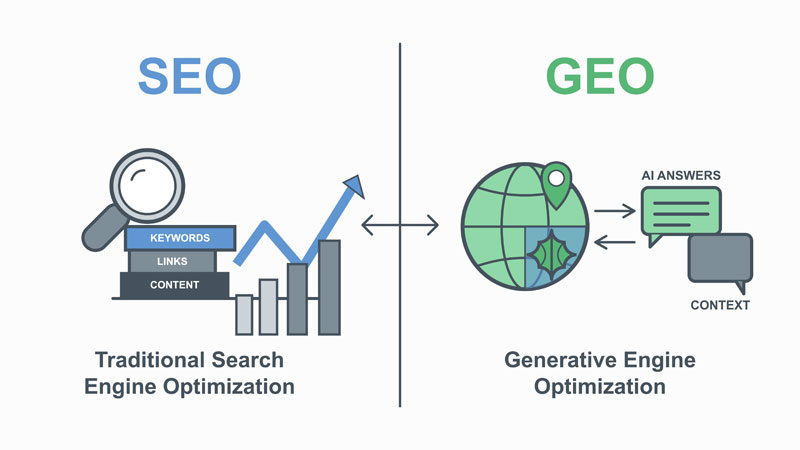
Search engine optimization (SEO) helps a business appear in traditional search engine results.
Generative engine optimization (GEO), meanwhile, helps increase the chances that a business or its content will appear in answers created by AI tools such as ChatGPT, Google AI Overviews, and Perplexity.
SEO and GEO work together. Good SEO helps search engines and AI tools find and understand a website. GEO builds on this foundation by making a business’s information clearer, more trustworthy, and easier for AI tools to use in their answers.
1. Search Rankings vs AI Citations
SEO usually aims to improve a webpage’s position in Google and other search engines. GEO focuses on whether a business, brand, product, or source is mentioned or cited in an AI-generated answer.
Ranking well on Google can support overall online visibility. However, a high ranking does not automatically mean that a business will appear in an AI response.
AI tools may look at several sources before deciding what information to include. This is why businesses need accurate and consistent information both on their websites and across other trusted platforms.
2. Keywords vs Conversational Questions
SEO often starts with keywords that reflect what people type into a search engine. GEO also considers the longer, conversational questions or prompts people ask AI tools.
For example, someone using Google might search for “digital marketing agency Manila.” while someone using an AI tool may ask, “Which digital marketing agencies in Manila can help a small business increase its online visibility?”
Both searches have a similar goal, but the AI question includes more detail. Businesses should therefore create content that does more than mention keywords. Their content should also answer real customer questions clearly and completely.
3. Website Authority vs Overall Online Reputation
SEO often focuses on the quality, relevance, and authority of a company’s website. GEO also considers how the company is represented across the internet.
AI tools may find information about a business from:
- Company websites
- News articles
- Forums (Reddit/ Quora)
- Professional profiles (Linkedin/ Youtube Channel)
- Business directories
- Customer reviews
- Industry publications
- Social media posts
- Other trusted third-party websites
When these sources provide clear and consistent information, AI tools can better understand what the business offers, where it operates, and what it is known for.
Mentions from trusted and relevant sources are more valuable than having many listings or references from low-quality websites.
4. Backlinks vs Citations and Third-Party Mentions
Backlinks remain an important component of SEO, particularly when they come from relevant and authoritative websites. GEO introduces another consideration: how frequently and accurately a business is discussed or referenced elsewhere.
Industry publications, directories, reviews and independent articles can all strengthen a brand’s digital footprint by reinforcing how the business is represented across the web. However, quality matters more than quantity, so the focus should be on earning relevant, credible mentions rather than simply increasing the number of references.
5. Website Clicks vs Visibility Inside AI Answers
SEO is commonly measured through keyword rankings, impressions, organic website visits, leads, and conversions.
These metrics largely reflect how effectively a business attracts users from traditional search results to its website. A strong SEO performance therefore often translates into measurable website traffic, where users click a search result, visit the site, and potentially take an action such as submitting an inquiry or making a purchase.
GEO introduces another form of visibility: appearing directly within an AI-generated response.
A potential customer might see a company’s name, service, or product recommendation without visiting the website immediately. Even without a click, that exposure can help the customer become familiar with the brand and consider it later.
This means businesses may need to look beyond website traffic when measuring their online visibility.
6. Search Result Pages vs Direct AI Answers
Traditional search engines like Google usually give users a list of webpages to explore. AI tools can get information from several sources and combine it into one direct answer.
Because of this, important business information should be easy to find and understand. This may include:
- Products and services
- Business locations
- Service areas
- Prices or price ranges
- Professional credentials
- Industry experience
- Product features
- Contact information
Businesses should avoid hiding important details behind vague marketing statements. Clear and specific information is easier for both customers and AI tools to understand.
7. Measuring Rankings vs Measuring AI Visibility
SEO can be tracked using established measures such as keyword rankings, search impressions, organic website traffic, and conversions. Measurement for GEO performance, on the other hand, is still developing. Businesses can check whether their brand appears in relevant AI responses, how often it is mentioned, whether the information presented is accurate, and which sources are being referenced.
Why GEO Matters for Businesses in the Philippines
AI-powered search gives Filipino consumers another way to discover and compare businesses. For companies in competitive sectors such as healthcare, finance, hospitality, education, e-commerce, real estate, and professional services, appearing in AI-generated answers can help a business become one of the brands a customer considers.
This matters even more in the Philippines, where consumers often move across multiple digital touchpoints before making a decision, including:
- Google search
- TikTok
- Online reviews
- Local directories
- Business websites
Together, these channels shape how a business is represented online. GEO, therefore, works best as part of a broader digital strategy that strengthens visibility, credibility, and consistency across the web, rather than as a standalone tactic for influencing AI tools.
Does SEO Still Matter for GEO?
Yes. SEO remains an important foundation for GEO.
Before an AI tool can mention a business, it must be able to find, understand, and assess the information available online.
A technically sound website with clear structure, useful content, and strong topical relevance gives businesses a stronger base for both traditional search and AI-driven discovery. Core SEO elements such as crawlability, internal linking, content organization, and authoritative references still matter.
In practice, many GEO recommendations build on established SEO principles, including:
- Answering real user questions clearly
- Publishing accurate and useful content
- Demonstrating relevant expertise
- Structuring information so it is easy to interpret
- Building credible references across the web
GEO does not replace SEO. It extends it by considering how content may also be understood, selected and presented within AI-generated answers.
Team Up With Digital Experts Today
As more customers use AI tools to search for products, services, and recommendations, businesses need to prepare for both traditional search and AI-powered discovery.
Investing in SEO can help build the website and content foundation needed for long-term online visibility. Adding GEO strategies can help a business remain visible as customer search habits continue to change.
If you’re looking to strengthen your online visibility, consult AMPH Advertising Agency to assess your current SEO foundation and identify practical opportunities for GEO readiness. From SEO and content strategy to local visibility and broader digital authority, we can help turn changing search behavior into a sustainable growth opportunity.
Frequently Asked Questions
Does SEO help with GEO?
Yes. Strong SEO provides an important foundation for GEO.
A technically accessible website, useful content, clear page structure, relevant expertise, and trustworthy information can help search engines and AI tools understand a business more easily.
Can a business rank on Google but not appear in AI answers?
Yes. Google rankings and AI visibility are related, but they are not the same.
A webpage can rank well for a traditional Google search without being selected, mentioned, or cited in an AI-generated response.
How can businesses measure GEO performance?
GEO measurement is still developing.
Businesses can check whether their brand appears in AI-generated answers for relevant customer questions. They can also monitor how often the business is mentioned, whether the information is accurate, and which sources are being cited.
These findings should be reviewed together with standard SEO results such as keyword rankings, impressions, organic traffic, leads, and conversions.
Can I run GEO without SEO?
While GEO can be implemented without SEO, a strong SEO foundation is essential for achieving more effective and sustainable results.
SEO helps search engines and AI-powered tools discover, access, and understand accurate information about your business. This includes having a technically accessible website, clear and relevant content, proper website structure, and credible online references.
Without these foundations, businesses may struggle to achieve consistent visibility in AI-generated answers. Rather than treating GEO as a replacement for SEO, businesses should use both strategies together. SEO establishes the foundation for online visibility, while GEO builds on it to expand opportunities for discovery through AI-powered search.